
A form will only show in your organisation's Form Library once it is Published. Before publishing a form, it’s essential to run tests and check for any issues. This guide walks you through how to test a form effectively and a checklist of common review items.
Open the Form You Want to Test in the Form Builder
1. Open the form in build that you want to test with. Click the Test button at the top-right of the header. You can do this from either version of the form (Draft or Published)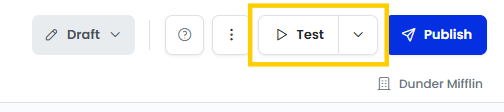
2. A popup will open, where you can name the test submission and decide who in your account can see it.
3. You can also link the test submission to a matter record, allowing you to use previous matter-data to prefill the form, and be saved for future use (see the warning below regarding this step).
4. Click Start test to begin testing the form. The form will open in a new tab.WARNING: Be careful linking to a matter record for a test submission, as connected integrations will still process any information submitted while filling out the test form and may create or update records. We recommend avoiding using real or live contact/matter data when testing.
For more information on linking a submission to a matter record in order to reuse data, click here.
5. Fill Out the Test Form
TIP: You can use the 'Use placeholder' toggle on each field (if available) to use placeholder text to fill it - speeding up testing.

6. Once you are done, hit Submit form.
7. A review page will appear giving you another chance to name the submission, send to integrations and review any matter record data updated/saved (learn more here). Any documents generated will appear for download or preview.
View Your Test Submissions
Once you have submitted a test form, the test will appear in the Tests table.
NOTE: When the form is in a Published state, you will only see tests of the published version of the form. Similarly, when in Draft, you will only see tests of the draft version of the form.
To swap between states, simply click the green Published button (or grey Draft button - depending on which state you are currently in) in the top bar to switch.
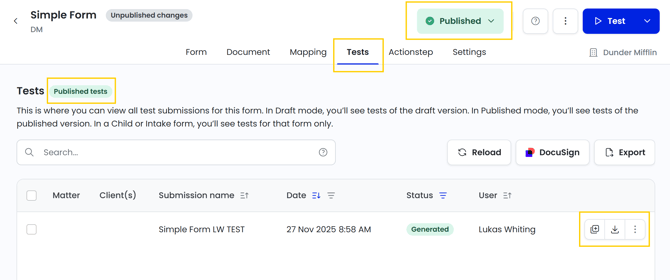
Once you find your test, using the action buttons on the right hand side of the row, you can:
- Clone the submission
- Download the generated documents (make sure you have a document template uploaded otherwise this option won't be available)
- View the details of the submission (including the form-fillers answers).
- Change who can access the submission
- Send the submission via webhooks or other integrations (if enabled), and
- Delete the submission.
If you started your form but didn't finish it (including saving and resuming later), you will also have the option to resume the form.
Tips and Best Practices for Testing
- Always submit at least one test submission before publishing (the more the better!).
- Stress test your form by:
- Trying out incomplete submissions.
- Submitting with unusual or unexpected inputs (long names, symbols, no data).
- Testing different combinations of answers that affect conditional visibility or logic.
- Using different sets of test data to cover various user scenarios.
- Add multiple repeating items if applicable (e.g. multiple directors).
- Remember: test submissions do not appear in the main Submissions tab.
- While developing a form, open the Test in a separate tab and keep it running in the background.
- As you fill in the test, click Save and Resume to retain answers.
- Then, as you make updates in the Builder, go back to the Test tab and press F5 to reload the latest form version and continue testing without starting from scratch.
Before You Publish Your Form
Review these common areas before publishing:
- Has the form been created in the appropriate folder?
- Has the form been named according to your organisation’s naming conventions?
- Have the fields been separated into sections correctly?
- Have the sections been split across pages correctly?
- Do all sections have an alias?
- If you want your form to be enabled for data-sharing (for more on data-sharing, click here):
- Do all relevant fields have an alias?
- Have record types been mapped to the appropriate fields?
- Have contact and user mapping been applied?
- Do repeating sections have the correct settings, limitations and calculations?
- Are the sections/fields in practical order?
- Have the correct field types been used?
- Have the questions been worded appropriately?
- Are the optional fields correctly set?
- Are the mandatory fields correctly set?
- Are any fields displayed that could be hidden – or vice versa?
- Are any guidance fields required?
- Has logic been applied to direct the form sections and fields correctly?
- Have all required conditional rules been created?
- Are any unique replacement rules required to be created or universal rules to be removed?
- Have the correct templates been attached?
- Have all required settings been completed?
- Have you designed the form to provide the best form filler experience?
Common Issues & Solutions
- Issue: The test button is disabled
- Solution: Make sure you have added at least one section and one field to your form (you cannot test a blank form).
- Issue: The test document doesn’t reflect my logic correctly.
- Solution: Check that your fields and conditional logic are correctly configured in the form. Use Preview to confirm behaviour.